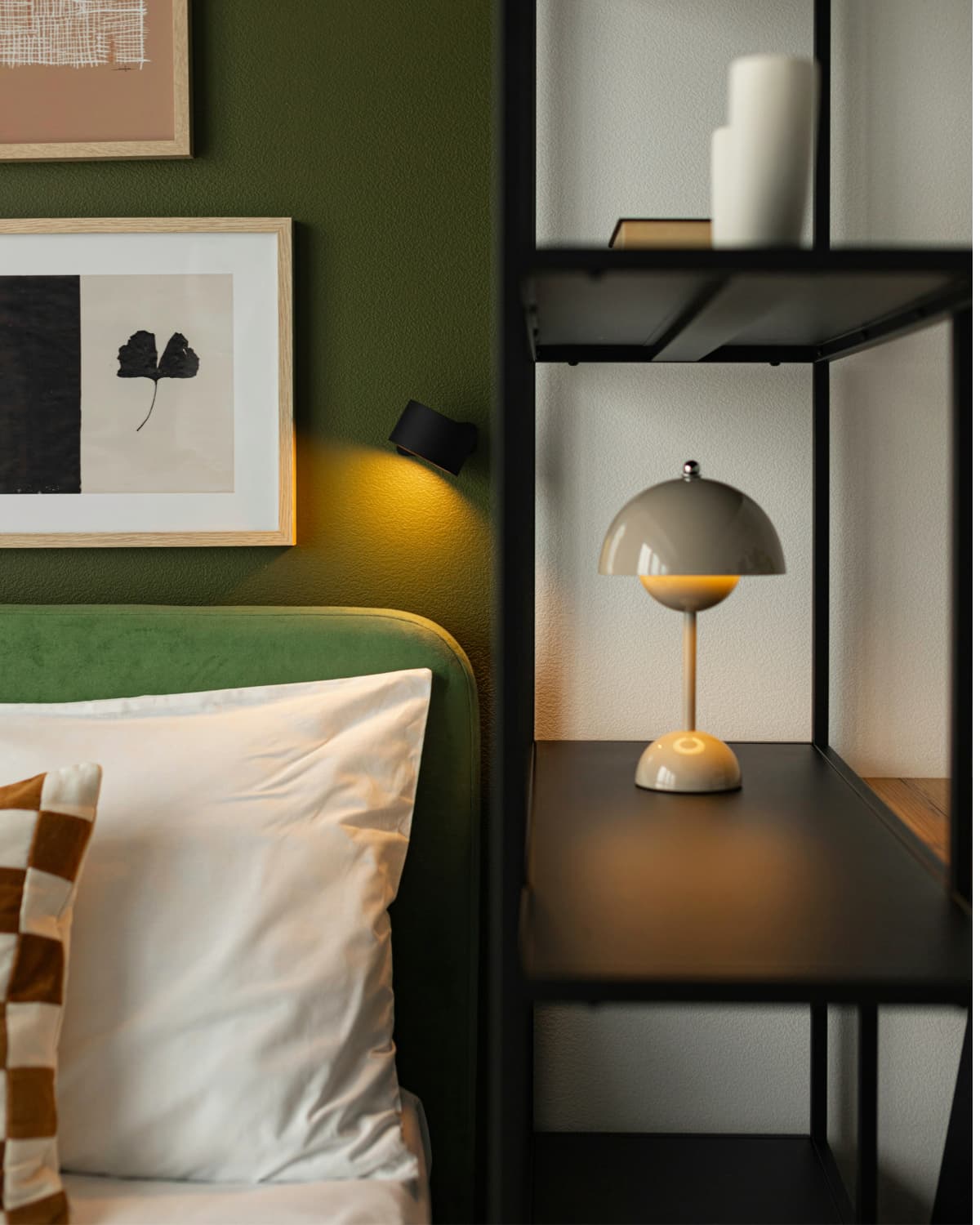
A 10×10 bedroom is small, but it is not impossible. The problem is that most “ideas” ignore measurements, so you end up with a room that technically holds the furniture but feels blocked, cramped, and hard to live in. This guide gives small bedroom layout ideas for 10×10 room and simple fit rules you can apply before you buy anything.
A 10×10 room is 120 in x 120 in. Everything that follows works by treating the room like a grid: you place the bed first, protect walking clearances second, and only then add storage and a desk.
This post may contain affiliate links. As an Amazon Associate, we earn from qualifying purchases.
Quick fit rules for a 10×10 bedroom (the checks that prevent bad layouts)
Before picking a layout, do these three checks. They are the reason some rooms feel “tight” even when the math looks okay.
1) Protect your walking lanes (don’t spend your last inches twice)
Pick where you must walk every day: bed-to-door, bed-to-closet, bed-to-bathroom (if ensuite). Then protect a lane.
- Target walking lane: 24–30 inches where you walk daily
- Absolute minimum for a tight pass: about 18 inches (only for occasional access, not daily flow)
If you ignore this, you’ll keep shifting furniture forever.
2) Decide what kind of bed access you need
Bed access changes everything.
- One-side access (bed against a wall): easiest way to fit a queen in a 10×10
- Two-side access (both sides clear): feels better, but costs more inches
- Three-side access (hotel-style): rarely realistic in a 10×10 unless the bed is smaller or storage is built-in
3) Use “real footprint” measurements, not product names
A “queen bed” is not one size in practice. You must account for the bed frame.
Use these mattress sizes as your baseline:
- Twin: 38 x 75 in
- Full: 54 x 75 in
- Queen: 60 x 80 in
Then add frame bulk:
- Minimal platform: +1 to 3 in per side
- Upholstered or storage bed: +3 to 6 in per side (sometimes more)
If you want a measurement-led way to avoid the “almost fits” trap, your closet and furniture choices get easier once you adopt a consistent sizing method like the one used in [THE SMALL-SPACE FIT KIT].
Small Bedroom Layout Ideas For 10×10 Room : A simple room map you can copy
Start by marking fixed constraints:
- Door swing zone (measure how far the door arcs into the room)
- Closet doors (sliding or swinging)
- Window wall (where radiators, outlets, or AC live)
Then use a simple “place-first” order:
- Bed
- Clearances (walking lanes + door/closet access)
- Storage (dresser/wardrobe)
- Desk or vanity (only if it still fits cleanly)
Below are small bedroom layout ideas for 10×10 room (with measurements) that follow that order.
Layout 1: Queen bed against one wall + slim nightstand + dresser opposite
Best for: couples who want a queen bed in a 10×10 without the room feeling locked.
Placement
- Put the queen bed long side against a wall.
- Keep 24–30 in of clearance on the open side of the bed.
- Place one slim nightstand on the open side (or a wall shelf if the floor is tight).
- Put a dresser on the opposite wall only if the bed-to-dresser clearance stays comfortable.
Measurement example
- Room width: 120 in
- Queen mattress: 60 in
- Target side clearance: 28 in
- Remaining: 120 − 60 − 28 = 32 in (enough for a slim nightstand or a narrow lane by the wall side if needed)
What to avoid
- Bulky nightstands (many are 18–22 in deep and become knee blockers)
- Deep dressers placed too close to the foot of the bed
If your closet is shallow or awkward, read [STANDARD BEDROOM CLOSET DIMENSIONS (REACH-IN VS WALK-IN)] so your bedroom layout doesn’t fight your closet access.
Layout 2: Full bed centered + two nightstands (the “balanced” 10×10 look)
Best for: people who care about symmetry and want two-side access without sacrificing all floor space.
Placement
- Center a full bed on the main wall.
- Use two small nightstands or wall-mounted shelves.
- Keep a clear path from the door to the bed edge.
Measurement example
- Full mattress: 54 in
- Two-side clearance target: 24 in each side
- Needed width: 54 + 24 + 24 = 102 in (fits inside 120 in, leaving 18 in for tolerance, baseboards, or thicker frames)
This layout often feels better than forcing a queen to be centered, because you preserve functional side lanes.
Layout 3: Queen bed in a corner + desk along the window wall
Best for: renters who need a desk but refuse to downsize from a queen.
Placement
- Push the queen into a corner (headboard on one wall, long side on the other).
- Place a compact desk along the window wall or the wall opposite the bed.
- Use one real nightstand on the accessible side.
Key measurement: desk depth vs walking lane
- Many desks are 20–24 in deep.
- If your remaining lane is under 24 in, the desk becomes a daily annoyance.
Practical tip
If you need storage without adding width, prioritize vertical solutions that don’t require wall drilling. Several renter-safe options are listed in [RENTER FRIENDLY STORAGE SOLUTIONS FOR SMALL APARTMENTS NO DRILLING!].
Layout 4: Bed under the window + dresser on the side wall
Best for: rooms where the door/closet placement makes the “usual” bed wall impossible.
Placement
- Put the bed headboard under the window only if it doesn’t block heating/AC and you can still open curtains easily.
- Place the dresser on the longest uninterrupted side wall.
- Keep your main walking lane on the side that leads to the closet.
What makes this work
- You’re using the window wall as “bed territory,” freeing your best wall for storage.
Common mistake
Putting a tall dresser directly under the window because it “fits.” It often blocks light and creates visual heaviness in a small room.
Layout 5: Minimal bed + wardrobe rack + open floor (the “renter reset” layout)
Best for: small closets, no closets, or seasonal clothing overflow.
Placement
- Use a simple bed frame with under-bed clearance.
- Put a freestanding wardrobe rack on the wall that doesn’t interrupt walking flow.
- Keep the center of the room open and treat storage as “perimeter only.”
This layout looks simple, but it is highly functional when your closet can’t hold daily life. If you want closet shelf spacing that actually matches what you store (instead of random shelf heights), use [STANDARD CLOSET SHELF HEIGHT WHAT ACTUALLY WORKS FOR DAILY USE].
Layout 6: Storage bed + one real walkway lane (small room, high storage)
Best for: people who need storage capacity more than open floor space.
Placement
- Choose a bed with built-in drawers only if you have space for the drawers to open.
- Keep one protected lane (bed to door and bed to closet).
- Replace bulky dresser storage with the bed storage.
Drawer clearance check (non-negotiable)
If your bed drawers pull out 18–24 inches, you must have that space clear in front of the drawer. Otherwise, you bought storage you can’t use.
This is where fit-first thinking pays off. If you want a repeatable measurement method that helps you choose storage and furniture faster, this is exactly what [THE SMALL-SPACE FIT KIT] is built for.
If you’re tired of re-measuring and second-guessing, use a consistent “fit validation” process once and reuse it room by room. [THE SMALL-SPACE FIT KIT] is a quick, self-guided way to check clearances, door swings, and storage depth before you buy.
The bed size decision for a 10×10 (what usually works best)
Most layout problems come from choosing the bed size first without deciding the lifestyle tradeoff.
Choose a queen if:
- You accept one-side access (bed against a wall)
- You will use slim nightstands (or wall shelves)
- You won’t insist on a large dresser plus a desk
Choose a full if:
- You want two-side access and calmer walking space
- You need both a dresser and a desk
- You want the room to feel less “bed-dominant”
Choose a twin/daybed if:
- The room must also be an office
- You want open floor space and a larger wardrobe solution
If you’re designing the whole apartment flow (not only the bedroom), [BEST SPACE SAVING FURNITURE FOR SMALL APARTMENTS COMPLETE 2026 GUIDE] helps you avoid furniture that technically fits but ruins movement.
Storage that doesn’t destroy the layout (what to pick in a 10×10)
In a small bedroom, storage must be shallow enough to keep lanes usable.
Dresser selection criteria (no price claims, only fit rules)
- Prefer dressers that are shallower over extra-wide (depth blocks movement more than width)
- Use drawer organization so you don’t need a second unit
- If your closet is weak, your dresser must compensate, but it can’t take your walkway
Nightstand alternatives that save inches
- Wall shelf (best when floor width is tight)
- Narrow cabinet (only if it stays out of the knee zone)
- Bedside caddy (works when the bed is against a wall)
For a calmer “less visual noise” approach that still stays practical, [HOW TO CREATE A CALM AND FUNCTIONAL HOME LIFESTYLE AND DECOR TIPS THAT TRULY WORK] is a good mindset reference for keeping a small bedroom from feeling cluttered.
FAQ
1) Can a queen bed fit in a 10×10 room?
Yes, but most successful setups use one-side access (bed against a wall) and keep the other side as the main walking lane. Centering a queen usually forces compromises in storage or daily flow.
2) What is the minimum clearance I should keep around the bed?
For daily use, aim for 24–30 inches on the side you use most. If you drop below that, the room may still “fit” but it will feel hard to live in.
3) How do I fit a desk in a 10×10 bedroom?
Use a compact desk (often 20–24 inches deep) and protect a walking lane. The easiest desk layout is usually queen-in-corner + desk on window wall.
4) Where should the dresser go in a small 10×10 bedroom?
Place it on the wall that does not interrupt the door-to-closet path. If the dresser makes you “side-step” daily, it’s in the wrong spot even if it fits.
5) What if my closet doors or bedroom door swing into the room?
Treat door swing zones as “no furniture” space. If you block a door’s natural arc, you’ll end up with constant daily friction and damaged walls.
6) Is a storage bed always a good idea in a small room?
Only if the drawers can open fully. Storage beds fail when there isn’t enough clearance in front of the drawers, turning “storage” into unusable bulk.
7) What’s the fastest way to make a 10×10 bedroom feel bigger?
Protect one clear lane, reduce bulky furniture depth (especially nightstands and dressers), and use hidden storage (under-bed bins) to clear surfaces.
Final Thoughts
A 10×10 bedroom works when you stop treating it like an inspiration board and start treating it like a measured plan. Use the same order every time: bed first, clearances second, storage third. Then choose the layout that matches your real daily life (two-side bed access, desk needs, closet limits), not the layout that looks best in a staged photo.
If you want to make this process repeatable across your bedroom, closet, and the rest of your apartment, the fastest path is to use a consistent measurement method. That’s what [THE SMALL-SPACE FIT KIT] is designed to help you do.